
Welcome to today’s blog post, where we delve into a critical aspect of successful trading: effective market analysis through the lens of volume and price action. In this case, I explain through a live NASDAQ trade as shown in my most recent video.
I’m Anthony Speciale with Hawkeye Traders, and I’m excited to share insights that can transform your trading strategy.
Today, we’ll explore how to identify key market signals, interpret volume and price action, and use these tools to enhance your trading performance.
The Power of Volume and Price Action
Understanding volume and price action is fundamental to successful trading.
These two elements provide a window into market dynamics, allowing traders to make informed decisions based on market behavior.
At Hawkeye, we emphasize the importance of these tools and provide comprehensive resources to help traders master them.
Identifying Market Signals
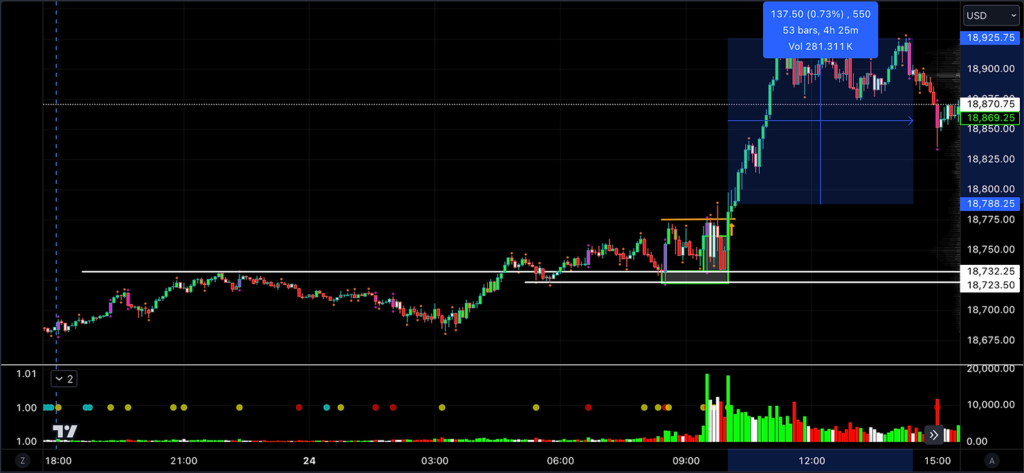
One of the first steps in market analysis is identifying significant price levels and volume surges. Let’s break down a recent NASDAQ trade to illustrate this.
Step 1: Recognizing Key Levels
Early in the morning, the NASDAQ built a base that was ripe for a breakout.
The first crucial step was identifying the low point, which serves as a support level.
Observing high volume surges and wide bars—key indicators provided by Hawkeye—can highlight these critical areas.
These wide bars and volume indicators draw attention to significant market movements, whether they signal a reversal, continuation, or another meaningful event.
Step 2: Understanding Volume and Price Interaction
Volume and price action are interconnected, providing context for market moves.
At Hawkeye, we teach traders not just to use indicators but to understand the story they tell.
For example, at 8:30 AM, an ultra-high volume radar dot and a wide bar signaled significant activity.
These indicators suggest that something important is happening, prompting traders to pay close attention.
Patience Pays Off
One of the hardest lessons for traders is learning to wait for the right opportunity.
It requires discipline and experience to let the market come to you rather than rushing into trades.
By putting in the time and observing market conditions, traders can develop a deeper understanding of when to act.
Step 3: Contextual Analysis
Looking at prior price action can provide valuable context.
For instance, identifying the overnight high and how the market reacts around these levels can offer clues about future movements.
Drawing lines on the chart to mark these levels can help visualize where support and resistance are likely to occur.
Trading the Breakout
When the market breaks out of a consolidation phase, it often presents a lucrative trading opportunity.
Here’s how to approach it:
Step 4: Waiting for Confirmation
Rather than jumping in as soon as the market moves, wait for confirmation.
A close above a significant level—such as the wick of a high-volume candle—can confirm the breakout.
In our example, waiting for the market to retest this level after breaking out provides confirmation and a potential entry point with less risk.
Step 5: Managing Risk
Risk management is paramount.
Placing your stop loss just below the retest level minimizes risk while maximizing potential profit.
By waiting for the retest, you can enter the trade with a tighter stop, reducing the amount you stand to lose if the trade doesn’t go as planned.
The Results
In our NASDAQ example, the market confirmed the breakout with a strong close above the significant level and retested it, providing a low-risk entry point.
This setup allowed for a substantial profit as the market moved significantly in a short period.
The Hawkeye Advantage
At Hawkeye, we equip traders with the tools and knowledge needed to make informed decisions.
Our software highlights key market signals, and our Mastery course teaches you how to interpret these signals within the broader market context.
By focusing on volume and price action, you can develop a robust trading strategy that prioritizes risk management and increases your chances of success.
Volume and price action should be at the forefront of your trading plan.
They provide critical insights that can help you understand market movements and make better trading decisions.
If your current results aren’t meeting your expectations, I encourage you to revisit your trade plan and consider incorporating volume and price action analysis.
At Hawkeye, we are dedicated to helping traders grow and succeed.
Trading is a journey of continuous learning, and with the right tools and mindset, you can achieve consistent success.
If you found this post helpful, please like and share it. Leave a comment with your thoughts or questions, and I’ll respond personally. Don’t forget to subscribe to our channel for more valuable insights. Stay disciplined and focused on risk management.
Happy Trading,
Anthony Speciale
Hawkeye Traders
Big Energy Profits


